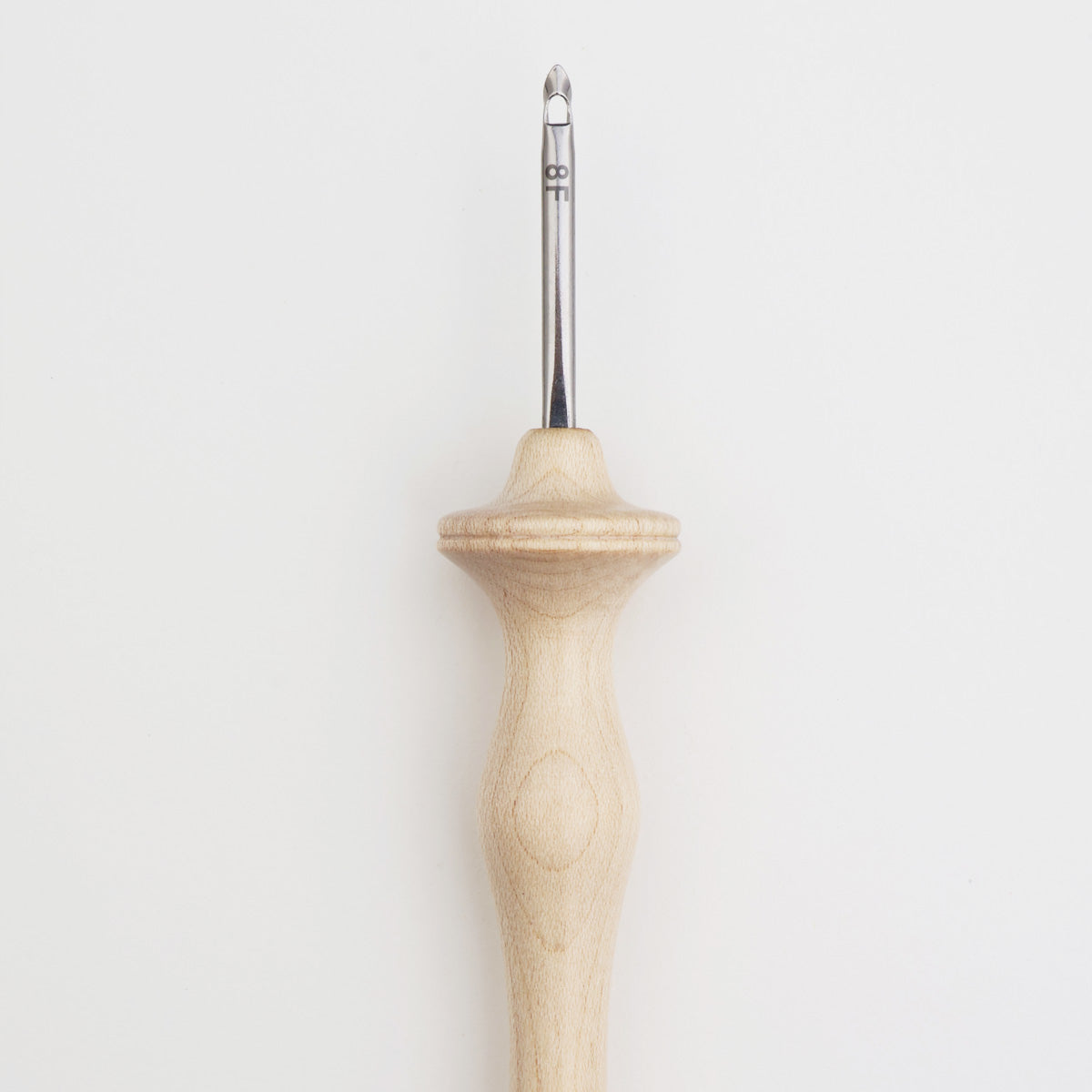
Oxford Punch Needle

Bring Your Rugs to Life ... With the Oxford Punch Needle!


Hand Punching on Monk's Cloth

Frequently Asked Questions
Answered by Amy Oxford

How Does Punch Needle Rug Hooking Work?
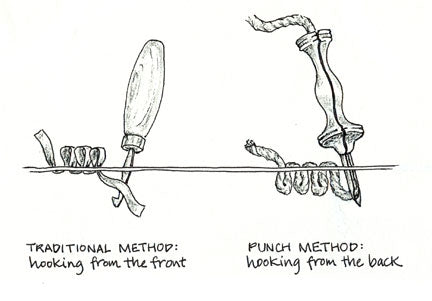
The needle forms a continuous loop stitch. Every time you poke the needle down, it pushes down a long end of yarn. When you bring the needle back up, it folds this end into a loop. There are no knots used. The tightness of all the loops packed together keeps it from unraveling. You work from the back side of the rug, so as a novice keep turning over your work to check that your loops are all the same length on the front side of your work.

Sign up for our EMAIL LIST!

My stitches keep pulling out! What am I doing wrong?

  1. Make sure that you always punch your needle ALL THE WAY DOWN as far as it will go into the rug backing.
  2. When you move forward to punch your next loop DON’T LIFT YOUR NEEDLE UP TOO HIGH! If you do, that will pull your loops right out! Instead of lifting your needle up, drag it along the surface of the monk’s cloth.
  3. Remember that your yarn needs to be able to flow freely through the punch needle at all times! Check for the following problems: Do you have a knot in your yarn? Is your yarn getting caught on your frame, under your arm or hand? Is your yarn tangled? Try putting your ball of yarn in a coffee can to keep it from rolling all over the floor.

My loops are all uneven heights, what am I doing wrong?
Make sure that you follow steps 1-3 above. If you do these things and your loops are still uneven try tightening your monk’s cloth on the frame. Tighten it a lot! Loose monk’s cloth can cause uneven loops. Your monk’s cloth should be as tight as a drum! We make every effort to manufacture the best punch needles possible but regret that every once in a while our Oxford Punch Needles do break. It is highly unlikely, but there is a slight chance that your needle has come unglued – that the metal needle has slipped in the wooden handle. If this happens to you we apologize and hope that you will send it back to us for an immediate replacement or for your money back. We are proud of our tools and offer a lifetime guarantee, no matter how many rugs you’ve made, or how many “miles’ you’ve put on your punch needle.

Rug Hooking Methods

What is the difference between punch needle rug hooking and traditional rug hooking?
Traditional rug hooking started in around the 1830’s and uses a rug hook, which is a short crochet-like hook in a wooden handle. A rug hooker pulls their loops up with their hook. Punch needle started in the 1880’s and is done with a punch needle. A puncher punches their loops down with their punch. Basically, hookers pull loops up and punchers punch loops down. Because punch needle isn’t done with a hook it isn’t technically “hooking.” Many people call punching “hooking” because it forms the exact same running loop stitch. 

Latch Hooking
Latch Hooking

Is this the same as latch hook?
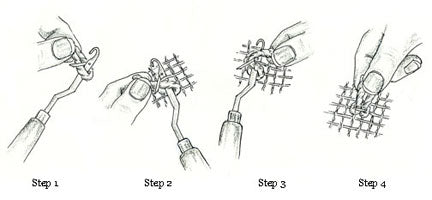
No. Latch hooking is done on a mesh backing with 1/4” wide square holes. Rug yarn is precut into 2 1/2” lengths. The yarn is knotted into each square of the mesh with a latch hook. This tool has a little hook with a catch at the end that makes it easy to knot your yarn. A shag effect is created because both ends of the yarn stick up forming a pile approximately 1 1/4” tall. This rug method is not technically considered rug hooking. It is however one of the more well-known methods of home rug making. The main differences are that latch is knotted and has a cut pile and punch is a running stitch with uncut loops and no knots.

I’m a beginning puncher and the right side of my rug is a complete mess! I hate it! There are long threads sticking out and I can’t even see my design. I like the wrong side better! Help!
Don’t panic! Take a deep breath! Because we work on the back side of our rugs (the wrong side) we don’t have that much control as to what is happening on the right side. It is common for loops to punch through other loops – splitting them and making them look uneven or pushing them out of place. Also, because we push all of our finished ends to the right side, the right side will be all hairy! After you punch you need to clean up the right side of your rug. Everyone does it – you haven’t made a mistake at all! Here’s how to clean up:

  1. Cut off all of those long ends so they’re level with your loops. We call this “snipping.” When you do this, the cut ends will blend right in. Cut them off one at a time, don’t cut clumps of them together or they will show.
  2. Clean up your lines and outlines. Take control of your rug! We call this “poking.” Do this with your closed scissors or another pointy tool (like an awl or the end of your punch needle). Poke your loops around and don’t be afraid to really maneuver them into place. Push them into place until each loop is where you meant for it to be. This can take some time but is really worth the effort. A well-made rug should be beautiful on both sides. It is a good idea to “snip” and “poke” as you go. My book includes some before and after pictures. The results are dramatic.

Do you sell punch needle rug hooking supplies such as monk’s cloth, frames, yarn, patterns or kits?
No, we only sell Oxford Punch Needles and the books that I’ve written. Please visit the Links section of this website for referrals to some of my favorite businesses that sell these additional supplies. Please note that many of my hooked rug designs are available through Red Clover Rugs.

Does my punch needle ever need to be sharpened?
No, they just get better and smoother with age. The only time you might run across a problem is if you drop it on a cement floor and get a “burr” on your needle. If this happens, mail it back to us and we will replace the needle for you at no charge. You can also try removing a burr by filing it carefully with a metal nail file.

There are no knots in hooked rugs? Why don’t they pull out?
Hooked rugs have so many loops packed in tightly together that the tension keeps the loops from pulling out. Also, the small holes in the rug backing grip the loops and help to keep them in place. In addition, when you’re punching, loops tend to punch through other loops. This helps to hold the rug together. The only thing that unravels these rugs seems to be puppies that chew them, or cats that knead them with their claws. Beater bars on vacuum cleaners can also be dangerous.

How should I clean my rug?
It’s fine to vacuum your rug as long as you don’t use a beater bar. Sweeping them with a broom is fine too. Punch needle rugs may be dry cleaned by a reputable dry cleaner. Woolite® Foam Rug Cleaner works well for spot cleaning or when you want to clean a rug quickly. Follow the directions on the can for a heavily soiled rug (even if your rug isn’t heavily soiled.) Simply spray the foam all over the top of your rug, rub it in with a damp sponge, let it dry, and then vacuum. Remember to always test an inconspicuous area of the rug first before using this product.

Your rug may also be hand washed in the sink or bathtub in COLD WATER ONLY with Woolite® or Ivory Liquid®. Before you wash it, take it outside and give it a good shake until all the loose dirt comes out. Wash it the same way you would wash a wool sweater. Never washed a wool sweater? It's easy! Just add some Woolite® or Ivory Liquid® to a tub full of cold water and put in your rug to soak. Rub the rug gently, don’t wring or twist it. The water will probably be filthy!

Drain the tub and refill it with clean cold water. Soak your rug in the clean water, rub your rug around, and dunk it in and out to get the soap and dirt out. (This is called rinsing.)  You will probably need to drain the tub again, add fresh cold water, and rinse several times until the water is clear. When the rinse water is finally clear, drain the tub and gently squeeze and press the water out of your rug. (Again, don’t wring or twist it). To dry your rug, place it on top of a clean dry towel. Replace the towel as needed with a dry towel. A thick rug can take two or three days to dry.

Another cleaning product that many fiber artists love is called Eucalan®. With this soap, you wash your rug as described above, but no rinsing is required.

I never put my rugs in the washing machine and I never use hot water. One of my students ruined her rug by washing it in hot water - a red yarn in her design bled and ran into her white background. Some companies claim that their yarns won’t run, and several of them are telling the truth. But why risk it? I like to err on the side of caution…

The old fashioned way to clean hooked rugs is to put your rug face down in fresh snow. Gently beat the rug with a broom and keep moving your rug and beating it until the snow comes out clean. You can also rub snowballs on areas to help remove dirt. After doing this, I then put 2-3 inches of snow on top of my rug and sweep it off with a broom. I know this wintery method sounds crazy, but it really works. Obviously this method isn’t always practical or possible.

Can you please explain your crazy punch needle size numbering system?
Crazy isn’t it? Maybe this will help to clear it up: When I first designed my punch needle, I based my numbers on my favorite punch needle, The Craftsman’s Punch Needle , which I had used for many years. This is an adjustable tool with ten different settings so you can use it to punch ten different loop heights ranging from ¼” to ¾.” I chose the settings that I used the most, and decided to make my punch needles in those sizes (see illustration below). In addition to the #8, #9, and #10 settings found on The Craftsman’s Punch Needle, I also make two shorter needles, a #13, and a #14.

Craftsman Needle Heights
Griffin Rug Machine

When was the first punch needle invented?
As far as we know, the first punch needle was invented in 1881. Called “The Griffin,” it was patented by Ebenezer Ross in Toledo Ohio. Since that time, there have been over 100 different brands of punch needles. Early punch needles were advertised and marketed to be used with both yarn and fabric strips. (Similarly, the first “traditionally” hooked rugs were made with both yarn and strips as well. Early rug hookers used whatever materials they had on hand. What a wonderful luxury we have today to have so many beautiful fibers at our fingertips!)

Do I have to work on a frame?
I strongly recommend it. If your rug backing is stretched nice and tight it is SO much easier to punch. Your needle will zip right through the backing! I’ve tried punching without a frame and found it very difficult. One exception to this is Oriental style punch needle rug hooking. With this technique, you punch in every hole of a monk’s cloth rug backing and going “frameless” seems to work well. For more information on this technique, visit American Heirloom.

Can I use an embroidery hoop instead of a frame?
You definitely can, but it isn’t the best way to go. I find that an embroidery hoop doesn’t keep my work tight enough. Punching the needle in and out loosens up the backing and I have to keep constantly tightening my work. Morgan makes a nice embroidery hoop that they call the Morgan No-Slip Hoop. It is readily available online, in craft shops and at sewing stores.

What kind of a frame would you recommend?
Honestly, all you really need for any project is one small frame. You can hook a rug a section at a time and move your work on the frame as needed. (How to move your rug is described below.) Most punch needle rug hookers don’t like moving their rugs because it’s time consuming. They tend to have two frames: one for small projects, and one for rugs.

I use a little lap frame to make smaller pieces such as chair pads. This frame is like a sturdy picture frame, and its interior dimensions are 16” X 16”.  I hold the bottom of it in my lap and rest the top of it against a table when I work. It’s made out of wooden canvas stretcher bars (available from art supply stores). I attach carpet tack strips to the frame (available from stores that sell wall-to-wall carpeting). Carpet tack strips are narrow bars with angled tacks sticking out of them. I stretch my monk’s cloth over these tacks. (They are SHARP so use caution!) After I stretch my backing onto the frame, I cover the carpet tacks with rolled up fabric, old towels, foam core, or other padding. This is to protect my hands from the carpet tack when I work! Another protective padding I like to use is the heavy felt padding that’s normally used as rug under-padding by carpet installers. (This is also available from stores that sell wall-to-wall carpeting.) I cut this into 1 ½” strips. I can often get this stuff for free as installers often have scraps left over from their projects that are too small for them to use. My book, Punch Needle Rug Hooking, has directions for making your own simple lap frame with carpet tack strips.

I have played around with different size lap frames. The biggest size I like to use is 21” X 29” (interior dimensions). I find that anything larger than this is too awkward to hold in my lap. You also might want a more petite, manageable frame than this. It’s a good idea to make yourself a “mock” frame out of cardboard to see what size you’re comfortable with.

Frame
A small inexpensive handmade lap frame made with canvas stretcher bars and carpet tack. The felt padding is for covering the nails to protect your hands. Interior dimensions: 16” x 16” This close-up shows the carpet tack strip nailed to the inside edge of the frame.
Fraser Frame
Fraser Frame

For rugs, I use larger frames on legs or stands. One of these is “The Fraser Frame” made by the Harry M. Fraser Company. Fraser Frames come in several different sizes. The one I use is 16 ½” X 42”. They don’t come with the carpet tack so you will need to add your own, or attach your rug to the frame with sturdy thumbtacks.

Card Table Frame
Card Table Frame

I also use a large frame that I made called a “card table frame.” This is a simple idea – all I did was take a large rectangular frame and screw card table legs to the bottom of it! You can buy an old card table at a yard sale and remove the legs. Card table legs can also be found online or can be special ordered from some hardware stores. As with my lap frame, I attached carpet tack strips to the top of this frame. My card table frame is 30” X 40” (interior dimensions). I like this frame because I can make a 2’ x 3’ rug without moving it at all. Remember: when making yourself a frame, don’t make it so wide that you can’t reach the middle!

The Puncher Frame
The Puncher, by Tom Anderson

There’s a new frame on the market that I would strongly recommend called The "Puncher". A terrific frame made by Tom Anderson from Maryland, it uses special rounded pins instead of carpet tack. (No more worrying about scratching yourself!) One real plus with this frame is that it has well-designed levers which make it easy to get your backing tight. It is also beautifully crafted and will look gorgeous in your living room. I had the honor of testing this frame for Mr. Anderson and I think it’s a great product.

Degraff Frame
DeGraff Frame

Jerry DeGraff, from Hinesburg, Vermont, makes a very nice standing frame that I like a lot and featured in Punch Needle Rug Hooking. There isn’t a very good picture of this frame in my book because it is always covered with a rug, but you can see it in use on pages 50 and 62. It’s sturdy, well made and handsome and has served me well for many years. Just for fun, I painted mine green to match my studio. The frame is available with or without carpet tack, and is also available with carding strips (shown here). For more information about the frame, contact Jerry at daveyinvt@yahoo.com, or call (802) 482-2720.

Do you ever use a “Puritan Style” lap frame with carding strips?
You can use a frame with carding strips (these strips are covered with metal teeth, similar to those on a dog brush). Just be careful when you take your rug off the frame that you remove it very carefully so your loops don’t snag and pull out. In Punch Needle Rug Hooking, I recommend not using them at all but I’ve had a change of heart after seeing many people use them successfully! CAUTION!! Only move your rug on a frame with carding strips if you are using heavy 3-ply wool rug yarn or wool fabric strips! More delicate yarns will snag and pull out when you move your rug! This can be heartbreaking and remember, this is supposed to be a fun and relaxing craft...

Most Puritan style frames are usually very small. This doesn’t appeal to me because I punch quickly and don’t like having to move my rug all the time. Angela Jones from Breezy Ridge Rugs in Raywick, Kentucky sells some nice larger frames with carding strips that are very well made.


I’m working on a frame with carpet tack strips. Can I move my rug on the frame?
Yes! But beware! When you move your rug, don’t put the part that you’ve already punched on top of the nasty carpet tack! It will pull out your loops! Eek!  Here’s a step-by–step guide for moving your rug:

Step 1: Plan ahead so you move your piece as few times as possible. This usually means starting on one end of the rug, or in a corner – not in the middle!
Step 2: Hook the first section of your rug.
Step 3: When done, take this off the frame.
Step 4: Figure out what area you want to punch next.
Step 5: Lay your rug gently on top of the frame in this area.
Step 6: Anywhere that you have carpet tack touching punched loops is not good!
Cover the carpet tack in these areas with felt, foam core, or rolled up fabric. (This means that some of your carpet tack will be covered, but some will not.)
Step 7: Stretch your rug gently on the frame. Don’t make it tight yet.
Step 8: You can’t stretch where your carpet tack is covered with padding. Argh! Now what?
Step 9: In these areas use 1 ½” common nails to nail your rug to the wooden frame. Obviously, don’t just hammer with reckless abandon! CAREFULLY place the tip of the nail between the loops, push down gently, and then hammer!

Caution: When moving your rug, make sure that you line it up so it stays the right shape! In other words, be careful that your circle doesn’t become an oval, and that your rectangular rug doesn’t wind up having a bend in the middle! Just eyeball your rug each time you move it to make sure it keeps its shape. Also, stagger your ends where you have to move the rug so it isn’t obvious where you stopped and restarted.

How to move your rug is hard to describe in words. For a complete step-by-step description complete with photographs, please see my book, Punch Needle Rug Hooking.

“The Puncher” (frame mentioned above) makes it easy to move your rug! It uses pins instead of carpet tack and these pins can go right through your hooking without pulling out your loops. Similarly, the frames from Jerry DeGraff and Breezy Ridge Rugs (also mentioned above) have carding strips instead of carpet tack, which makes moving your rug quite uncomplicated. (For more about this, see the above question, “Do you ever use a ‘Puritan Style’ lap frame with carding strips?”) If you don’t have a lot of strength in your hands, I would go with “The Puncher,” or a frame with carding strips.

What weight yarns should I use?
In my regular point Oxford Punch Needles:
I use 3-ply 100% wool rug yarn. This is a similar weight to bulky knitting yarn and is approximately 1/8” thick. I like rug yarn because it’s more durable than knitting yarn. It’s made from a coarser and stronger fleece than knitting yarn and is spun tighter as well. I always use wool in my rugs for high-traffic areas. After all my hard work, I want my rug to last. Wool wears so well! Really, there’s nothing like wool… For low-traffic areas and wall hangings I use all kinds of things. Cotton, jersey, linen, mohair, alpaca, angora, blends and synthetics, are all terrific. If I like the looks of it, I’ll try it! For example, cotton chenille makes gorgeous bath mats. Don’t be afraid to experiment. There are some really cool “novelty yarns” out now and many of them are really affordable as well. I will often double, triple, and quadruple finer yarns and use them together in the punch. Basically, you can use any yarns that are up to 1/8” thick. Stay away from yarns that have thick lumps in them because these lumps won’t go through the punch. Similarly, designer yarns that are very shaggy and hairy won’t work. Some slippery yarns, such as silk, will fall right out of the punch. If a slippery yarn doesn’t work on its own, try combining it with something else. Experiment! Have fun! Try different yarns and combinations to see what you like!

In my fine point Oxford Punch Needles:
I use worsted weight yarn, sock weight, baby weight, tapestry yarn, and needlepoint yarn. Again, avoid yarn with lumps, hairy yarns, and yarns that are very slippery. Embroidery floss doesn’t work!

I want to punch using fabric strips. What size punch needle should I use? How wide should my strips be?
To get the look of traditional primitive hooked rugs, use a #10 Regular Oxford Punch Needle and ¼” wide strips of wool fabric.

In rug hooking, ¼” wide strips are called #8 cut. Why, you might ask? Good question! Strip cutting machines come with different size cutter heads. The sizes are based on thirty-seconds of an inch, so a #1 cut is 1/32” wide, a #2 cut is 2/32” wide, a #3 cut is 3/32” wide, etc. Thus a #8 cut strip is 8/32" wide. If you remember your fractions from school 8/32” is the same as ¼”.

For the traditional look, some rug hookers prefer using #6 cut strips instead of #8 cut. The #6 cut strips are a bit narrower and glide more easily through the punch needle.

Punch with fabric strips

Yes! You can punch with fabric strips! Top: #14 Fine Oxford Punch Needle (“The Mini ) threaded with a #3 cut strip. Bottom: #10 Regular Oxford Punch Needle threaded with a #8 cut (1/4”) strip.

Can I use strips in “The Mini?”
Yes, #3 cut strips work really well. Anything thicker than a #3 cut strip won’t feed through the needle. I suggest using lightweight wool such a flannel. Coat weight wool is often too thick.

Can I use strips of fabric and yarn in the same piece?
Yes! It works wonderfully!

I’m a traditional rug hooker. Can I make part of my rug with a rug hook, and the rest of it with a punch needle?
Yes. Just remember that you use a rug hook on the front side of the rug and the punch needle on the back. You might want to have your design on both sides of your backing. Some people like to do the punch needle part first, and then do the actual hooking to match the loop height of the punch. Others prefer to do the hooking first and to then choose a punch needle size that matches their hooking.

Star Flower Rug

Star Flower Rug. Made by Celia Oliver, Shelburne, Vermont. Design adapted from an antique rug at Shelburne Museum. This rug combines traditional rug hooking and punch needle rug hooking First Celia worked the stars, flowers, leaves, and stems with a hook, then she filled in the background using a punch. Celia used a #10 Oxford Punch Needle.

What size monk’s cloth should I use?
I use monk’s cloth that has 12-14 holes per inch. Caution: they make a monk’s cloth with 6-7 holes per inch. Avoid this! Your loops will fall out - leading to the tearing out of hair and gnashing of teeth.

Do I have to use monk’s cloth? Can I use linen or burlap?
With the regular point Oxford Punch Needle you can use monk’s cloth and rug linen. Rug linen has the same thread count as monk’s cloth (12-14 holes per inch), but it’s stiff, and not as easy to use as monk’s cloth. It also tends to be more slippery, and you have to be much more careful while punching. However, this is just my opinion. Some people prefer linen to monk’s cloth. Unbleached rug linen is great for "looks" if you aren’t punching the entire piece, and want to leave some backing showing.   

The fine point Oxford Punch Needle works well with monk’s cloth, rug warp, and rug linen. When I’m working on monk’s cloth, I like to wash it and dry it first to shrink the holes. I find that this helps the loops to stay in. It isn’t essential, but if you try it, you’ll notice the difference. I have tested several other different linens and have liked working with 20 and 27 count Belgian linens.  You can also punch directly onto wool fabric. I use a lightweight wool, such as flannel (the same kind they make wool flannel shirts out of…) This is nice to do because you only have to punch the motif, and the wool backing itself can become your “background.”

Avoid burlap like the plague. The sharp punch needle will break the burlap threads. I’ve seen it happen, and it’s not pretty! Also, burlap is made from Jute, and will get brittle with age and fall apart.

How much yarn will I need?
For rugs, using a #8, #9, or #10 Regular Oxford Punch Needle:
It takes approximately 2/3 of a pound of yarn per square foot.

Illustration of Hand Method

To figure out yarn amounts you can also use “the hand method.” To do this, simply place your hand on your rug and draw a generous imaginary circle around your hand (this is based on a large man’s hand so make the circle approximately 9” in diameter.) This circle is the equivalent of one 4 oz. skein of 3-ply rug yarn. You can measure your whole rug in this manner and estimate smaller areas by estimating whether they are a quarter of a hand, a half a hand, etc. The hand method is designed to give you a bit more than you will need so you won’t run out. With practice you will become comfortable with this method. It may sound unscientific, but it really works.

For the #14 Fine Oxford Punch Needle (the “Mini”):
It takes 1.3 yards to cover a square inch.
I did a little test when I invented the “Mini.” I took one ounce of Violet Jane worsted weight rug yarn and measured it. It was 40 yards long. I hooked a square, starting in the middle and spiraled my way outwards until I ran out of yarn. This one ounce of yarn made a 5 ½” square. Here’s the formula for using worsted weight yarn in the mini:

It took one ounce of worsted weight yard to make this 5 1/2 inch square
It took one ounce of 
worsted weight yarn 
to make this 5  1/2 inch square using "The Mini"

1 oz. worsted weight yarn = 40 yards
This makes a 5.5 inch square
5.5inch X 5.5inch = 30.25 square inches
40 yards ÷ 30.25 square inches = 1.3 yards per square inch

Are you using different types of yarn or different punch needle sizes? Weigh one ounce of yarn and make yourself a test square like I did. Use the same formula shown above and you will know exactly how much yarn you will need. You might want to add 10% extra yarn, just so you don’t run out!

How long does it take to make a hooked rug?
A fast puncher, using bulky weight rug yarn, can punch a square foot in approximately three hours. This doesn’t count all the time it takes to figure out what colors to put where! I tend to spend a lot of time taking things out and re-punching until I’m happy. Obviously, the more detailed and complicated the rug, the longer it will take. I haven’t had a chance to time myself using the new “Mini” needle yet! Everything I’ve made has been kind of complicated and I think I’ve spent more time pulling things out than putting them in! I did punch the 5 ½” square (shown above) to see how far one ounce of worsted weight rug yarn would go. It took me about 40 minutes to punch, but I was chatting with a friend, watching TV, and eating snacks at the same time…

Is there anything special I need to know if I design my own rug?
Remember that your design has to be backwards because you are working on the back of your rug! Be especially careful about this if you are doing lettering.

How do these rugs hold up?
If you use wool, a good rug backing, and good technique – your rugs will last for generations.

Can I jump over other stitches when I’m punching?
You can, but I wouldn’t! It will weaken your rug. I got a rug to repair once and whoever made it had jumped hundreds of times. Most of these stitches pulled out and I had to re-punch all of them. For a wall hanging it would probably be OK to jump, but don’t jump far!


Back to Top